History of Filipino Masonry:
|
|

Icons of Freedom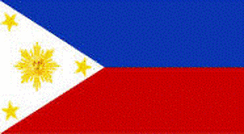
At the start of the 1896 revolution, various standards were used by revolutionary leaders to rally their troops. Collectively, all these flags served as symbols of the struggle for freedom. The ultimate symbol was the flag brought home by Gen Emilio Aguinaldo in 1898 which became the official flag of the country.
|
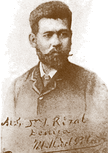
Marcelo H. del Pilar:
|
The Katipunan Ideology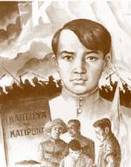
The Katipunan was not just a cry for freedom. It was a national aspiration made flesh. It caught the passion of ordinary people, willing to stake their lives and overcome the dread of reprisals; believing that worse fate awaited their families if they did not stand up to face their oppressors. It was a secret society that had a formal hierarchy composed of a supreme council and local councils, and a ritual of membership often mistaken for Masonry. Moreover, it had an ideology embodied in its Ang Kartilya ng Katipunan, authored by Emilio Jacinto.
|
Thirteen Martyrs of Cavite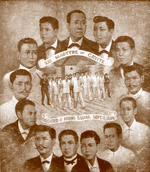
At the outbreak of the revolution, thirteen men were executed on September 12, 1896 in Cavite Puerto. Ten were Freemasons: Maximo Inocencio, Jose Lallana, Eugenio Cabezas, Maximo Gregorio, Hugo Perez, Alfonso de Ocampo, Luis Aguado, Victoriano Luciano, Severino Lapidario and Feliciano Cabuco. The non-Masons were Francisco Osorio, Antonio de San Agustin and Agapito Conchu. They were later called the Thirteen Martyrs of Cavite.
|
The Philippine Republic, 1899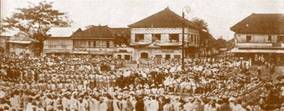
After independence was declared on June 12, 1898 in Kawit, Cavite, Aguinaldo organized local governments, appointed diplomatic agents and called for a representative assembly. Schools were reopened, a national high school a university and a military academy were also established. The assembly also known as the Malolos Congress was convened on September 15, 1898. It drafted a forward looking republican constitution which was promulgated on January 21, 1899. The Philippine Republic was inaugurated in conspicuous ceremonies two days later on January 23, 1899. With a civil government in place, the Philippines became a free and sovereign country; the first democratic republic in Asia.
Tragedy of the Republic
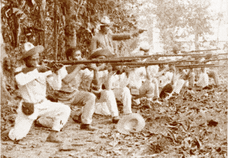
Under the contention that they did not recognize Philippine independence, Spain and the United States entered into a settlement called the Treaty of Paris. However, President McKinley declared sovereignty over the archipelago even before the treaty was ratified by U.S. congress. Before its scheduled ratification, a Filipino soldier was fatally shot which started an armed confrontation. The infant Philippine republic was at once plunged into a war with its supposed ally and protector, the United States of America. |
The First Unfurling of the Philippine Flag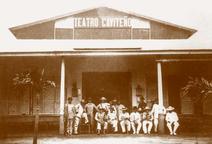
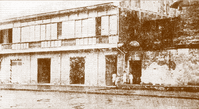
The first successful battle fought by the Filipinos in the renewed revolution against Spain took place in Alapan, Imus, Cavite on May 28, 1898. The Spanish prisoners were brought to Teatro Caviteno, the general military headquarters of the Filipino revolutionary army. In acknowledgement of their first victory, General Aguinaldo brought out the Philippine flag and in the presence of his men and the crowd unfurled it amidst the tremendous applause and loud, spontaneous and prolonged cheers for “Independent Philippines.” May 28 is now celebrated nationwide as Philippine Flag Day.
The Republic at War
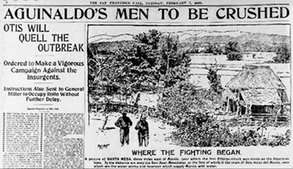
Filipinos were deprived of the civil government under the newly established Philippine Republic. Barely 12 days after its inauguration, the country was forced into a war against its supposed ally. What was more tragic and ironic, their first president General Emilio Aguinaldo and his army were declared "insurgents" by the Americans; "insurgents" in their own country they themselves liberated. The United States poured in tremendous amount in both manpower and resources to defeat the Filipinos; inflicted atrocities and relocated entire barrios in relocation camps to isolate them from the Filipino forces fighting a guerilla war. The war or what the Americans called "insurgency" was declared over by 1902 but in reality, resistance continued until 1913.
|