Masons in Philippine History
|
|
Graciano Lopez Jaena was initiated in Masonry in 1882 at Logia Porvenir No. 2 in Madrid; took the Masonic name Bolivar, and later served as its Worshipful Master. He also became a member of the original Logia Solidaridad (No 359) of the Grande Oriente de España.
Years later, he helped organize Logia Revolución No 65, which was chartered in April 1889 under the auspices of newly established Grande Oriente Español of Grand Master Miguel Morayta. He became its Worshipful Master, with Mariano Ponce as Secretary and Marcelo del Pilar as a member. It was here where Ariston Bautista, Galicano Apacible, Jose Alejandrino and many other Filipinos were initiated.
At this time, with the Grande Oriente Español being constituted and registered in accordance with the laws pertaining to associations of the civil government of Madrid, Freemasonry in Spain was considered legal or at least tolerated.
Logia Revolución was the first Masonic Lodge founded by Filipino Masons abroad hence, this move was considered the first concrete step towards the formation of Philippine Masonry.
Graciano Lopez Jaena was an eloquent Filipino orator who showed anti-friar wit at an early age of 18 when he started his satire Fray Botod. Botod was a fictional priest he likened to a furry seal without whiskers; a “barrigón” (fat bellied; thus botod in Hiligaynon), ignorant, abusive, lecherous and immoral, with a warped sense of piety. It was not actually published, but the friars got hold of a manuscript and suspected him. However, they could not prove that he was its author.
Lopez Jaena was born in Jaro, Iloilo on December 18, 1856. He wanted to be a physician and enrolled at the University of Santo Tomas in Manila. However he was not admitted for lack of the required Bachelor of Arts degree which was not offered in his first school, the Saint Vincent Ferrer Seminary in Iloilo. He was instead asked to apprentice at the San Juan de Dios Hospital but later quit and returned to his home.
He engaged in some form of medical practice until he was asked to attest that some prisoners died of natural causes and not by the hands of the Mayor of the town of Pototan. His life threatened for his refusal, Lopez Jaena sailed to Spain in 1880. He enrolled in Medicine at the University of Valencia but soon lost interest and found his passion in writing and oratory.
According to Agoncillo (1973) his rise to fame as an orator started in 1882 in Madrid during the International Congress of Commercial Geography when he stood up to defend the indio and refute the statements of Fray Ramon Martinez Vigil who was extolling the “benevolence” of the friars he once visited in the colony. Lopez Jaena was so impressive that even Spaniards were awed by his eloquence in the Spanish language.

Teatro Real de Madrid

Poster for the universal exposition in Barcelona.
|

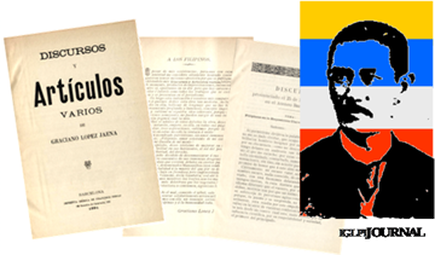
Lopez Jaena wrote many articles and speeches which he compiled into a book titled “Discursos y Articulos Varios” published in 1891. From this book can be seen some of his memorable experiences. One notable speech was in 1883, when he was invited to speak at the “Banquete en honor á Colón con motivo del CCCXCI aniversario del descubrimiento de América” (Banquet to honor Columbus in celebration of the 391st anniversary of the discovery of America) held at the prestigious Teatro Real de Madrid. He was interrupted with a prolonged applause when he spoke of America (with its geographic location) as the brains of the commercial world and the Philippines as the converging point of the arteries and veins of that commercial world. But, he called attention to the plight of the millions of Filipinos living in a semi-feudal state, oppressed by the intolerance and fanaticism of the friars; without a free press and not having any representation in the Spanish Parliament. At the end of his impassioned speech, the Venezuelan ambassador embraced and thanked Lopez Jaena on behalf of the peoples of Latin America. |
On another occasion, February 25, 1889, he spoke at the Ateneo de Barcelonés, a cultural center founded in Barcelona in 1860. His lecture was themed: “Filipinas en la Exposición Universal de Barcelona” where he regaled his audience with a vivid, colorful description of the Philippines with its flora and fauna, its sceneries, natural resources, traditions and wealth; then lamented the apathy and negligence of the central government and lambasted the friars in the country whom he called the personification of intransigence and impediment to progress declaring that “. . . monasticism and progress can never live together.” Praising the exhibition of Philippine products, art and sculpture Lopez Jaena called the exposition a brilliant protest against the label of laziness and indolence imputed upon the Filipinos.
As awareness to the Philippine situation gained ground, the need for a continuing, sustainable propaganda campaign gave rise to the fortnightly La Solidaridad, subtitled Quincenario Democrático. It was co-founded and edited by Graciano Lopez Jaena and financed by Pablo Rianzares. Its first issue appeared on February 15, 1889 in Barcelona. In its first editorial, he explained its aims:
“Our aspirations are modest. Our program, aside from being simple, is clear: to combat reaction, to stop all retrogressive steps, to extol and adopt liberal ideas, to defend progress, in a word, to be a propagandist, above all, of democratic ideas in order to make these supreme in all nations here and across the seas.
“The aims, therefore, of La Solidaridad are described as to collect, to gather libertarian ideas which are manifested daily in the field of politics, science, art, literature, commerce, agriculture and industry.
“We shall also discuss all problems relating to the general interest of the nation and seek solutions to these problems in a high-level and democratic manner.
* * * * * * *
“With regard to the Philippines, since she needs the most help, not being represented in the Cortes, we shall pay particular attention to the defense of her democratic rights, the accomplishment of which is our patriotic duty.
“This nation of eight million souls should not, must not be exclusive of theocracy and traditionalism.” (In History of the Filipino People as cited by Agoncillo, 1973)
On its 19th issue, November 15, 1889 La Solidaridad moved to Madrid. Its editorship was transferred from Graciano Lopez Jaena to Marcelo del Pilar, who would continue its publication until its last issue on November 15, 1895.

Lopez Jaena received no compensation as editor of the La Solidaridad except food and lodging and sometimes, some pocket money for incidental expenses. He was said to have an eccentric character and his friends would chide him for the way he dressed and for his spending most of his time in cafes to imbibe in wine and spirits. Finally his eccentric ways and life style caught up with him. On January 20, 1896, Graciano Lopez Jaena died of tuberculosis and was buried in a pauper’s grave in Barcelona.